Comics and Graphic Narratives
Thursday, December 8, 2011
Web-comics
This week was another week I had been looking forward to immensely. Even though I haven't always had time to keep up with my normal comics, I've consistently kept up with at least twenty web-comics at a time. They're quick and easy to access and super fun and free to follow without any hassle. Web-comics are such a great innovative medium, and I feel like they could go so much farther and are barely being accessed to their full potential. I wish more people read them (and talked about them!), and that more people made them, because they're just so personal and awesome and have infinite possibilities, and I love reading them so much. Irrelevant to the comics I read for the assignment, I wanted to post links to some of my current favorite web-comics (not already on Mr. Steiling's to-read list):
The Abominable Charles Christopher: http://www.abominable.cc/2007/06/20/episode-1
Sin Titulo: http://www.sintitulocomic.com/2007/06/17/page-01
The Zombie Hunters: http://www.thezombiehunters.com/index.php
The Meek: http://www.meekcomic.com
Best Friends Forever: http://bff.nematodeinspace.com
Roza: http://www.junglestudio.com/roza
Sfeer Theory: http://sfeertheory.littlefoolery.com/uitspanera/pages/e01_01.html
Emily Caroll's short web-comics: http://www.emcarroll.com/comic
Johnny Wander: http://www.johnnywander.com
Last Blood: http://lastblood.keenspot.com
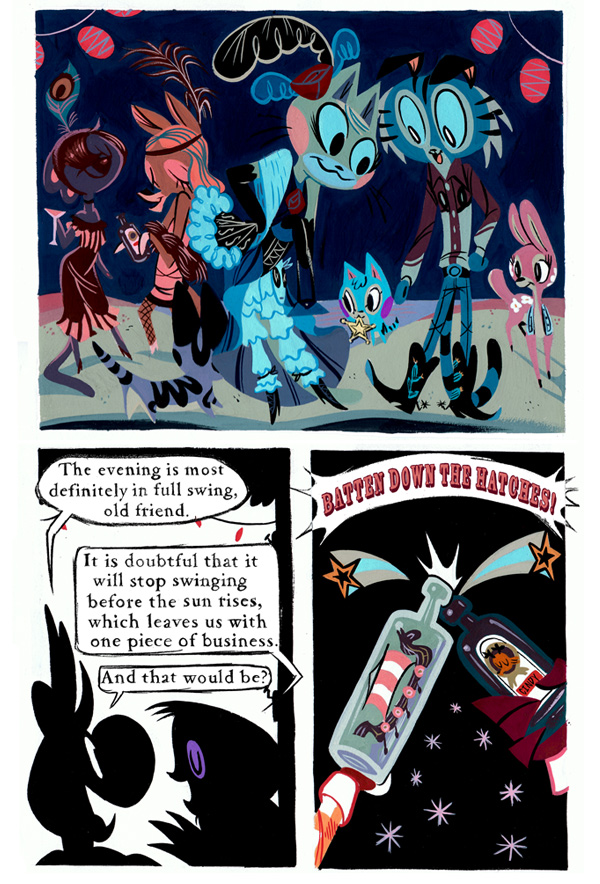
I feel like I'm missing quite a few I had wanted to share, but oh well haha. SO ANYWAYS, yeah, I was super excited to get a whole bunch of web-comics to go through, and I went through and read a bit of everything. I had read part of or been following a lot of comics suggested, but for a couple I had already tried at another point and gave up on, I gave another chance and decided to stick to, notably Octopus Pie and Scary-Go-Round. Both of which are a little bit crazy and frantic with their humor and characters, pretty silly and childish, but also entertaining. Octopus Pie is really good and has me hooked now, and I've been working to catch up since there are so many pages. I love the characters and their expressions, and their personalities really shine through and are differentiated and developed. Scary Go Round has been kind of hard to follow because it's so juvenile and almost seems like it was written by someone who's first language isn't English (I'm not sure if that's that case, but it just might be...) because there are a lot of typos and grammatical errors, and the language is difficult to understand at times. I'm not sure if I'll continue following it for much longer, but so far the funny character discussions have been keeping me interested. Tiny Kitten Teeth is another web-comic I read quite a few pages in but haven't caught up yet. I really enjoy the stylization - how they look like brightly-colored paper cut-outs, and how cartoony and adorable all the animals are. The audience follows the main cat character, Mewsli, through his adventure to a new town. He seems like a normal decent guy (cat...), which makes us especially empathetic to him and hold tightly as he tries to integrate into this strange new environment. I'm still not entirely sure what's happening - the way things have worked out so conveniently for him makes it feel like it's all a conspiracy to use him in some way. Out of everything though, I mostly read and enjoyed Shadoweyes. The premise of the random transformation in the beginning is strange and handled well in some ways and just made awkward in others (especially regarding relationships), but overall the story feels like it's entrenched in a living, existing world and that drew me in immediately. In the beginning I didn't like Shadoweyes herself all that much, but have grown to really like her character - she's revealed herself more as the story goes on, and I find myself identifying with more and more of her ideals and decisions. The setting is grungy and almost post-apocalyptic, with the city in ruins and crime running rabid, and everything is illustrated really nicely. I've always really liked the tied-together elements of a hero balancing school, friends, crime-fighting, and family life, and Shadoweyes does that all within a bigger looming mystery - though it hasn't been revealed yet. So far I really like the story though despite some of the awkward and slightly over-looked elements, and plowed through it when I first started reading. I'm going to keep following it and the others for sure, and I'm so happy we finally got around to web-comics and got an awesome list to read from.
Since I guess this is going to be my last post, given that the last class "meeting" is tomorrow, I really wanted to thank Mr. Steiling for being such an awesome teacher. I've absolutely loved this class and always wish I could write so much more here than I do, but alas, I don't have all the time in the world. I've enjoyed each and every reading assignment and learned so much from them though - each one was a memorable experience unto itself, and has helped inform my opinion and infinitely foster my love of comics. Without this class I wouldn't have had the chance to read any of these amazing stories, and probably would've never swung back into comics as I have now. I have more motivation than ever to read them in my free-time, and fully intend to go back and finish reading all of those that I've downloaded and never finished or gotten to. This has been such a wonderful class, and I'm thankful to have been apart of it.
Thanks for a wonderful experience, Mr. Steiling!
Batwoman: Elegy by Greg Rucka
I absolutely adore superhero comics and everything that comes along with them, so I've been waiting and super excited to finally get to modern-day superhero comics. I was a little disappointed with our visit to old comics, because we didn't really discuss them, and all we did discuss was how cheesy they were - which is fine, because they are, but because superhero comics are such a massive part of the industry and pretty much formed everyone's opinions of comics as they are now, it was a little disappointing that we didn't actually talk about their influences overall. I wish we had gone more in-depth in comics the last few class meetings, because the analyzing and psychological parts were discussed less and less than they were in the beginning, and the focus was more asking us about what we read and getting a few people's opinions on certain things as opposed to discussing everything together. I went over every comic on the suggested reading list and started The Authority by Warren Ellis and Promethea by Alan Moore, and briefly looked at Criminal and League of Extraordinary Gentlemen, but I only entirely read Batwoman: Elegy by Greg Rucka. I had really wanted to read Umbrella Academy since I've had it on my to-read list for years, but didn't get the time. I actually have the first book back at home but never got the chance to read it either, but the concept and style of the comic have always really interested me since it came out. Now that I have a bunch more downloaded though, I'll definitely read them over Christmas break. But anyways - so I read Batwoman: Elegy and had decided upon it mostly because of the art style. Looking through the other comics, it was an easy choice art-wise, and plus I've never really read a full Batman or DC superhero comic before, so I felt like my comic experience was lacking in that regard. I'm also a sucker for action beginnings, and as Batwoman begins with her interrogating a guy and beating the crap out of him in an alley, I was immediately intrigued and wanted to know what was happening. The art also drew me in because it was so well-drafted and gorgeous - minimal colors with black, white, gray, and red, clean, confident lines with a hint of grungy textures, and of course, a whole bunch of beautiful, abstract tapestry-like design elements interwoven throughout the pages. Batman made a brief cameo before Batwoman discovered her final clue that led her to a meeting place and time for the gangs in town, coming together for the first time to greet their new mobster "queen" as she arrived in Gotham. Though there isn't much character development for Batwoman apart from showing that she's the generic sexy, ruthless badass lady, more comes to the surface during this conflict with the strange Alice-themed mob-boss, and a mysterious previous history unfolds between them. I will admit that the plot of the comic is lacking and not as character-based and sophisticated as I would've liked, it was still entertaining enough to keep me going along, and the art definitely kept me there. I'm not sure of the general quality of art for DC comics, but I was surprised it was so well-done and consistent, and had loads of abstract design elements to the page layouts and such as well.
Tuesday, December 6, 2011
Asterios Polyp. & Petrograd
Asterios Polyp. by David Mazzucchelli is a very well-designed comic, and much more abstract and psychology-based than most comics. People in class gave it extremely high praise, so I had pretty high expectations, but it didn't really live up to them. It was pretty and had cool design elements that abstractly represented the mind and Asterios' thought process, but I just didn't think he was very interesting as a character. The comic overall was pretty slow and hard to get into for me, and I kept waiting for something to happen. I actually liked the mechanic's wife best; she was the most interesting of everyone, and I wanted to get to know her much more than Polyp., who was pretty boring. Sometimes I wasn't even sure why we were following him. The dead twin aspect and conflict was kind of cool, but I didn't feel like it was well-utilized and the way it manifested didn't seem realistic to a person's personality. I think part of the reason the book wasn't very entertaining was that the plot followed his relatively uneventful life and didn't seem to lead anywhere. Overall the art was really interesting and pretty though - very minimalist and simple in color and style, with strong, geometric shapes and well-designed characters.
For the next week, graphic fiction and graphic non-fiction, I read Petrograd, a historical comic based in Russia during the World War, which details the life of a British man sent to Russia. Immediately the man is very likeable and gentlemanly and I connect to him throughout his conversation with the old Russian lady. To be honest, I decided to read this comic partly because it deals with Petrograd and a similar era (19th-20th century Russia) and event (assassination of an important political figure) as The Fall, a gorgeous historical comic in the Assassin's Creed series. The art style reminds me of Blankets by Craig Thompson, except instead of blue as an overall color theme it's a rusty orange, and the characters are stylized slightly more realistically. I really love the lineart though - the line weight adds a lot of dynamism and movement and the environments are perfectly detailed and implied enough to pull the viewer in and hold them within this beautiful foreign world. The panels and story are well laid-out and paced with a steady flow that keeps you reading. Overall I really liked the comic, but I wonder how much of it is actually historically accurate and how much of it is fiction.
Wednesday, November 2, 2011
Blacksad - Book 1
Blacksad is absolutely gorgeous. I like to see what all the comics on the reading list look like and decide which one I'll read based on that and if I've heard that they're any good, but upon seeing Mariana reading Blacksad, I was sold. I downloaded it immediately and I couldn't stop glimpsing at the pages over her shoulder. And as of yet, each gorgeous, hand-painted page hasn't left me in any less awe. The panels are extremely well laid-out so that each page is like an illustration unto itself. The pacing is natural and flowing, and I love the clever dialogue and how the story unfolds as we follow detective Blacksad, despite him not even saying much in the comic. This novel-like detective story reminded me of L.A. Noire in themes, characters, and even style - but was done so well and refreshingly that it feels like a new genre entirely. I love how all the characters are different animals, and they remain true to the animals' personalities. Blacksad himself is a cat, reserved and fierce. The story is played through him, but we don't know much about him at first - the viewer sees him as mysterious, and slowly picks up hints to piece together his past with the homicide of his ex-lover the book begins with. Through the story he comes along other animals such as a mouse maid, who is timid and subservient, a boxing gorilla, some bad-ass reptiles, and a bear and rhino mercenary, among others. The story is fun and interesting, and entirely addicting. I plan to read all of them eventually; and if anything, I'd love to just flip through the pages to stare at the gorgeous art.
Friday, October 21, 2011
Osamu - Buddha Vol. 1 & Bakuman
I also read the first book of Bakuman because we talked about it in class and it seemed really interesting. I had heard of the name before, but had no idea what it was about. Bakuman is a cute, kind of awkward love-story type manga. Saiko, the main character, starts off pretty boring and emotionless. He talks briefly about being a manga-ka, and while in class, sketches the girl he has a big crush on. It's the end of the year in middle-school and the kids have a half-day, so they leave class to go home and study, but Saiko forgets his notebook with the sketches. Returning to the school later, he finds the "class-genius," Takagi, was waiting for him with it, knowing he'd come back. In return for the notebook and keeping Saiko's crush a secret, Takagi says Saiko has to agree to become a manga-ka with him and draw for his written manga. The two argue and Saiko leaves despite Takagi's begging, saying he'll think about it. Later that night Saiko's mom catches him reading manga instead of studying and Saiko's suddenly becomes upset at people trying to dictate his future. Takagi then calls and tells him he's going to tell Asuki, Saiko's crush, his secret, and to meet him by her house. They meet up and talk to Asuki, Takagi telling her that he knows she wants to be a voice actor before pushing the stunned Saiko in front of her to confess his love. Panicked, Saiko instead tells her he'll be drawing for the manga Takagi will be writing, and that they would like her to be the voice of the heroine if it ever becomes an anime. She agrees, and then is stunned when Saiko blurts out that he'd like her to marry him. She runs back inside, then comes over the buzzer and agrees, but only if they never meet in person until their dreams come true. So begins the adventure - Saiko is so ecstatic and overwhelmed that he runs out and buys manga, more than happy to begin his life as a manga-ka despite his late uncle's failure. His current predicament mirrors his uncles, who also became a famous mang-ka in attempt to get a girl, but failed in the end, as the girl has become too high-class for him to feel comfortable to confess that he liked her. A couple years after his uncle had told him his whole story, he supposedly commit suicide, which had cemented the idea in Saiko's mind that he would never become a manga-ka. It was his reason for turning down Takagi's offer despite being a great artist, but when the time came and Asuki showed great excitement at the idea of them becoming manga-kas, whether he really wanted to do it or not, it became his singular goal.
The panels were really well-paced and nicely laid out, and I really liked the art style. The use of tones and articulation of forms in black-and-white were also gorgeous. To me it seemed like one of the few comics that actually looks a lot nicer in black-and-white than it could've been in color, just because it was so well-done - the color wasn't necessary. I really liked the expressiveness and the flowy line quality, especially in places like the characters' hair - I couldn't stop staring at the hair. So much niceness. The clothes also had really nice folds and movement in them, making the characters seem even more realistic and based in a real world, despite being anime-stylized. In a way I identified with Saiko because I'm really shy and have never gone for anyone, so even though the climax - him confessing he wanted to marry her - was a bit ridiculous, I was happy for him when she said yes and everything seemed to work out, when he had gone into the situation so uncertain. I noticed some Americanized elements too, such as the panel of Saiko's imaginary wedding scene, that seemed like a very stereotypical American wedding. It was funny that they included the obligatory Asian parent yelling at him for reading manga instead of doing homework, which seems to happen in every school-teenager manga. Overall I really liked this manga and it was a fun read. If I had more time I'd definitely like to come back to it and keep reading 8)
Thursday, October 6, 2011
Maus - Art Spiegelman
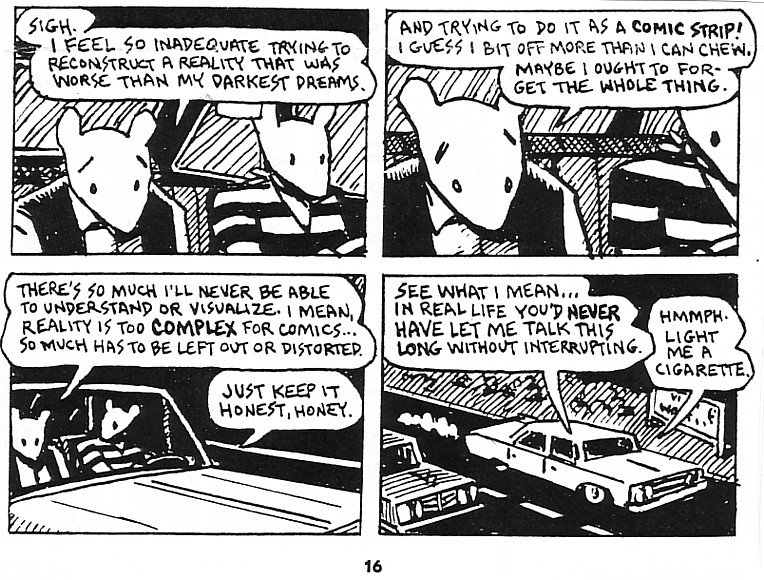
The story of Maus begins from around the 1930's and eventually leads up to 1944, and follows Vladek and his son, who interviews his father about his persecution by the Nazi's during World War II. The story sifts seamlessly between past and present as Art Spiegelman, the son, conducts his interview with his father over the years. At first Vladek's stubbornness and other touchy personality traits didn't really bother me, but as they became more obvious it started to bother me more how he had become like this when he had seemed to be such a different, happier person in the past. This story isn't like any normal historical literature. I think it's a really interesting take on history to put it into comic-book form like this - it's from a secondary source, but since it's illustrated and following a character who was fleshed out in the beginning, it makes history seem so much more real. As the reader you felt more connected because of this, so the tragedy feels even more dramatic and heartfelt. The reader can understand and even relate to Vladek's persecution since we are connected with him from the beginning (a good decision on his son's part to not just put in the history like any old history textbook. The bitterness Art's father exuded really did bother me after awhile though, in part because I remember when this wonderful lady named Patricia who had survived the Holocaust came to my school in 8th grade to give our class a talk about it and her experience, and she was one of the most lively and happiest people - she hadn't let this experience shape her whole life and bring her down, she had moved on and only told her story as a means to share information to a new generation. I feel like Vladek could've learned from another Holocaust survivor like this, one who put her horrible experiences behind her and knew the rest of her life she was would from then on could only be so much better.
Wednesday, October 5, 2011
Blankets - Craig Thompson
Blankets is the autobiographical tale of Craig Thompson's life - though he was only 27 when he wrote it - chronicling his life through boyhood and his teenage years, as well as early adulthood. The story begins with him as a young kid in middle school, supposedly somewhere around twelve or thirteen years old. The style is simplified, yet still holds relatively realistic proportions, and overall isn't too exaggerated. But in panels trying to capture his emotions or a conflict, the characters tend to become much more exaggerated in their expressions and movements to the degree of abstraction in some areas in order to better exemplify how he felt about them in the moment. He sets up the basic plot and themes for the rest of the story by explaining in his own words, how he had to sleep in the same bed with his younger brother in the exposed attic space. Though the words are narrating from a first-person view, they are in past tense, giving the sense that he is looking back on this portion of his life and the audience is peering into his memories and thoughts as he re-lives it. It begins in the winter-time, so the brothers playfully fight over the sheets like rambunctious little boys would, calling each other names and showing their playful relationship. Everything is fun until Craig is pushed from the bed from his little brother, and he falls to the floor loudly - his dad immediately stomps up the stairs from the clamorous thump, shouting at them to be quiet - this is the first display of how strict and short-tempered his parents are. The father's face throughout the scene is construed as over-exaggeratedly heartless and monstrous, the features blackened out in angry scribbles. The obedient fear towards his father made him feel helpless as his father takes his younger brother and shoves him in the spidery secret compartment and locks him in as punishment, where he cries quietly throughout the night. This scenario haunts Craig for the rest of the comic, as it makes him feel like he's a terrible, inadequate big brother. The audience follows Craig through what is a "normal" day for him in middle school, which is a miserable day by any comparison - bullies attack him multiple times throughout the day, making him late to class, which in turn causes the teacher to mock him, and later announce that the poem he wrote got an F and is rubbish. Upon returning home after such a horrible day however, when his mom asks how his day was, he replies that it was fine, showing that his days are probably normally pretty crappy, or else he would've complained to her. Boys his age (and throughout the teen years) tend to not consult with their mothers anyways, so his response also serves to illustrate both how normal and yet alienated he feels from people. Through scenes such as his fantasies in the nature around his house, the audience gets the idea that he is a loner and a day-dreamer. It's these thoughts that bring him to religion, which appeals to him as soon as he learns about heaven and how everyone is accepted there. He learns that it is a perfect place where everyone is happy, and immediately wants to go there to escape reality. His parents are Christian, as most families in the town appear to be, and force him to go to religious camp every year. Even there he feels like a loner among his peers, further depressing him and making him feel like a lonely loser - who isn't accepted at Christian camp? The comic sifts through his life timeline, jumping to his teen years as he goes through the motions and ends up at the camp every year. Though his childhood is revisited often in brief, random scenarios that further explain an aspect of his personality, the main time-line now follows him through his late teen years. At this point he has grown accustomed to going to camp every year and knows how to avoid the jocks and mean kids - he immediately looks for the "out-crowd," locating them on the fringes of the crowd of kids. Though he only gets along with the three guys in the group on a surface level, he immediately connects to the girl in the group, whom he quickly learns is named Raina. They separate from the group and quickly become best friends, doing everything together while escaping the guards that frequently try to force them into "required" activities such as church with the rest of the kids. Their relationship develops, and it isn't long before they both have feelings for each other and are obviously more than friends. The rest of the story continues to follow them and their relationship as it develops. Craig becomes extremely preoccupied with her, as he doesn't seem to have much else in his life besides his day-dreams and religion, which both keep him going along with spending time with her. They have many good times together, sharing special things with each other that they had never told or shown anyone else. They continue to grow closer before, later on in the story, Raina starts doing things Craig wouldn't expect of her, alienating him from her. He thought that they were both loners and both one in the same, but after she starts going to parties and participating in other social activities that he doesn't understand, their relationship falls apart. The story spirals, following his depressive emotions through his angsty thoughts. He says goodbye to her, moves out of his parent's house, and tries to move on, though the comic becomes mostly filled with his daydreams. In the end, they remain apart, but Craig finds a sort of equilibrium in his life and is able to move on.
Subscribe to:
Comments (Atom)