Thursday, December 8, 2011
Web-comics
This week was another week I had been looking forward to immensely. Even though I haven't always had time to keep up with my normal comics, I've consistently kept up with at least twenty web-comics at a time. They're quick and easy to access and super fun and free to follow without any hassle. Web-comics are such a great innovative medium, and I feel like they could go so much farther and are barely being accessed to their full potential. I wish more people read them (and talked about them!), and that more people made them, because they're just so personal and awesome and have infinite possibilities, and I love reading them so much. Irrelevant to the comics I read for the assignment, I wanted to post links to some of my current favorite web-comics (not already on Mr. Steiling's to-read list):
The Abominable Charles Christopher: http://www.abominable.cc/2007/06/20/episode-1
Sin Titulo: http://www.sintitulocomic.com/2007/06/17/page-01
The Zombie Hunters: http://www.thezombiehunters.com/index.php
The Meek: http://www.meekcomic.com
Best Friends Forever: http://bff.nematodeinspace.com
Roza: http://www.junglestudio.com/roza
Sfeer Theory: http://sfeertheory.littlefoolery.com/uitspanera/pages/e01_01.html
Emily Caroll's short web-comics: http://www.emcarroll.com/comic
Johnny Wander: http://www.johnnywander.com
Last Blood: http://lastblood.keenspot.com
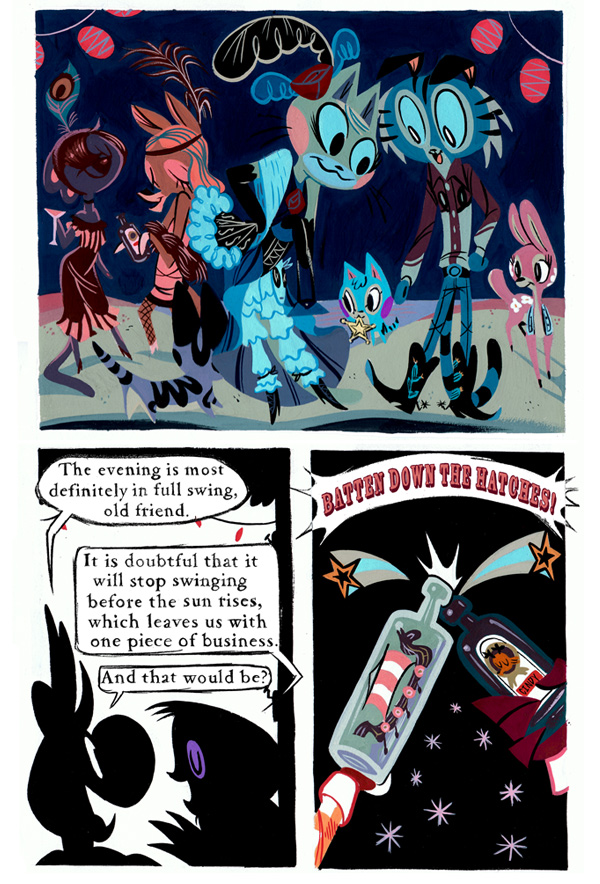
I feel like I'm missing quite a few I had wanted to share, but oh well haha. SO ANYWAYS, yeah, I was super excited to get a whole bunch of web-comics to go through, and I went through and read a bit of everything. I had read part of or been following a lot of comics suggested, but for a couple I had already tried at another point and gave up on, I gave another chance and decided to stick to, notably Octopus Pie and Scary-Go-Round. Both of which are a little bit crazy and frantic with their humor and characters, pretty silly and childish, but also entertaining. Octopus Pie is really good and has me hooked now, and I've been working to catch up since there are so many pages. I love the characters and their expressions, and their personalities really shine through and are differentiated and developed. Scary Go Round has been kind of hard to follow because it's so juvenile and almost seems like it was written by someone who's first language isn't English (I'm not sure if that's that case, but it just might be...) because there are a lot of typos and grammatical errors, and the language is difficult to understand at times. I'm not sure if I'll continue following it for much longer, but so far the funny character discussions have been keeping me interested. Tiny Kitten Teeth is another web-comic I read quite a few pages in but haven't caught up yet. I really enjoy the stylization - how they look like brightly-colored paper cut-outs, and how cartoony and adorable all the animals are. The audience follows the main cat character, Mewsli, through his adventure to a new town. He seems like a normal decent guy (cat...), which makes us especially empathetic to him and hold tightly as he tries to integrate into this strange new environment. I'm still not entirely sure what's happening - the way things have worked out so conveniently for him makes it feel like it's all a conspiracy to use him in some way. Out of everything though, I mostly read and enjoyed Shadoweyes. The premise of the random transformation in the beginning is strange and handled well in some ways and just made awkward in others (especially regarding relationships), but overall the story feels like it's entrenched in a living, existing world and that drew me in immediately. In the beginning I didn't like Shadoweyes herself all that much, but have grown to really like her character - she's revealed herself more as the story goes on, and I find myself identifying with more and more of her ideals and decisions. The setting is grungy and almost post-apocalyptic, with the city in ruins and crime running rabid, and everything is illustrated really nicely. I've always really liked the tied-together elements of a hero balancing school, friends, crime-fighting, and family life, and Shadoweyes does that all within a bigger looming mystery - though it hasn't been revealed yet. So far I really like the story though despite some of the awkward and slightly over-looked elements, and plowed through it when I first started reading. I'm going to keep following it and the others for sure, and I'm so happy we finally got around to web-comics and got an awesome list to read from.
Since I guess this is going to be my last post, given that the last class "meeting" is tomorrow, I really wanted to thank Mr. Steiling for being such an awesome teacher. I've absolutely loved this class and always wish I could write so much more here than I do, but alas, I don't have all the time in the world. I've enjoyed each and every reading assignment and learned so much from them though - each one was a memorable experience unto itself, and has helped inform my opinion and infinitely foster my love of comics. Without this class I wouldn't have had the chance to read any of these amazing stories, and probably would've never swung back into comics as I have now. I have more motivation than ever to read them in my free-time, and fully intend to go back and finish reading all of those that I've downloaded and never finished or gotten to. This has been such a wonderful class, and I'm thankful to have been apart of it.
Thanks for a wonderful experience, Mr. Steiling!
Batwoman: Elegy by Greg Rucka
I absolutely adore superhero comics and everything that comes along with them, so I've been waiting and super excited to finally get to modern-day superhero comics. I was a little disappointed with our visit to old comics, because we didn't really discuss them, and all we did discuss was how cheesy they were - which is fine, because they are, but because superhero comics are such a massive part of the industry and pretty much formed everyone's opinions of comics as they are now, it was a little disappointing that we didn't actually talk about their influences overall. I wish we had gone more in-depth in comics the last few class meetings, because the analyzing and psychological parts were discussed less and less than they were in the beginning, and the focus was more asking us about what we read and getting a few people's opinions on certain things as opposed to discussing everything together. I went over every comic on the suggested reading list and started The Authority by Warren Ellis and Promethea by Alan Moore, and briefly looked at Criminal and League of Extraordinary Gentlemen, but I only entirely read Batwoman: Elegy by Greg Rucka. I had really wanted to read Umbrella Academy since I've had it on my to-read list for years, but didn't get the time. I actually have the first book back at home but never got the chance to read it either, but the concept and style of the comic have always really interested me since it came out. Now that I have a bunch more downloaded though, I'll definitely read them over Christmas break. But anyways - so I read Batwoman: Elegy and had decided upon it mostly because of the art style. Looking through the other comics, it was an easy choice art-wise, and plus I've never really read a full Batman or DC superhero comic before, so I felt like my comic experience was lacking in that regard. I'm also a sucker for action beginnings, and as Batwoman begins with her interrogating a guy and beating the crap out of him in an alley, I was immediately intrigued and wanted to know what was happening. The art also drew me in because it was so well-drafted and gorgeous - minimal colors with black, white, gray, and red, clean, confident lines with a hint of grungy textures, and of course, a whole bunch of beautiful, abstract tapestry-like design elements interwoven throughout the pages. Batman made a brief cameo before Batwoman discovered her final clue that led her to a meeting place and time for the gangs in town, coming together for the first time to greet their new mobster "queen" as she arrived in Gotham. Though there isn't much character development for Batwoman apart from showing that she's the generic sexy, ruthless badass lady, more comes to the surface during this conflict with the strange Alice-themed mob-boss, and a mysterious previous history unfolds between them. I will admit that the plot of the comic is lacking and not as character-based and sophisticated as I would've liked, it was still entertaining enough to keep me going along, and the art definitely kept me there. I'm not sure of the general quality of art for DC comics, but I was surprised it was so well-done and consistent, and had loads of abstract design elements to the page layouts and such as well.
Tuesday, December 6, 2011
Asterios Polyp. & Petrograd
Asterios Polyp. by David Mazzucchelli is a very well-designed comic, and much more abstract and psychology-based than most comics. People in class gave it extremely high praise, so I had pretty high expectations, but it didn't really live up to them. It was pretty and had cool design elements that abstractly represented the mind and Asterios' thought process, but I just didn't think he was very interesting as a character. The comic overall was pretty slow and hard to get into for me, and I kept waiting for something to happen. I actually liked the mechanic's wife best; she was the most interesting of everyone, and I wanted to get to know her much more than Polyp., who was pretty boring. Sometimes I wasn't even sure why we were following him. The dead twin aspect and conflict was kind of cool, but I didn't feel like it was well-utilized and the way it manifested didn't seem realistic to a person's personality. I think part of the reason the book wasn't very entertaining was that the plot followed his relatively uneventful life and didn't seem to lead anywhere. Overall the art was really interesting and pretty though - very minimalist and simple in color and style, with strong, geometric shapes and well-designed characters.
For the next week, graphic fiction and graphic non-fiction, I read Petrograd, a historical comic based in Russia during the World War, which details the life of a British man sent to Russia. Immediately the man is very likeable and gentlemanly and I connect to him throughout his conversation with the old Russian lady. To be honest, I decided to read this comic partly because it deals with Petrograd and a similar era (19th-20th century Russia) and event (assassination of an important political figure) as The Fall, a gorgeous historical comic in the Assassin's Creed series. The art style reminds me of Blankets by Craig Thompson, except instead of blue as an overall color theme it's a rusty orange, and the characters are stylized slightly more realistically. I really love the lineart though - the line weight adds a lot of dynamism and movement and the environments are perfectly detailed and implied enough to pull the viewer in and hold them within this beautiful foreign world. The panels and story are well laid-out and paced with a steady flow that keeps you reading. Overall I really liked the comic, but I wonder how much of it is actually historically accurate and how much of it is fiction.
Wednesday, November 2, 2011
Blacksad - Book 1
Blacksad is absolutely gorgeous. I like to see what all the comics on the reading list look like and decide which one I'll read based on that and if I've heard that they're any good, but upon seeing Mariana reading Blacksad, I was sold. I downloaded it immediately and I couldn't stop glimpsing at the pages over her shoulder. And as of yet, each gorgeous, hand-painted page hasn't left me in any less awe. The panels are extremely well laid-out so that each page is like an illustration unto itself. The pacing is natural and flowing, and I love the clever dialogue and how the story unfolds as we follow detective Blacksad, despite him not even saying much in the comic. This novel-like detective story reminded me of L.A. Noire in themes, characters, and even style - but was done so well and refreshingly that it feels like a new genre entirely. I love how all the characters are different animals, and they remain true to the animals' personalities. Blacksad himself is a cat, reserved and fierce. The story is played through him, but we don't know much about him at first - the viewer sees him as mysterious, and slowly picks up hints to piece together his past with the homicide of his ex-lover the book begins with. Through the story he comes along other animals such as a mouse maid, who is timid and subservient, a boxing gorilla, some bad-ass reptiles, and a bear and rhino mercenary, among others. The story is fun and interesting, and entirely addicting. I plan to read all of them eventually; and if anything, I'd love to just flip through the pages to stare at the gorgeous art.
Friday, October 21, 2011
Osamu - Buddha Vol. 1 & Bakuman
I also read the first book of Bakuman because we talked about it in class and it seemed really interesting. I had heard of the name before, but had no idea what it was about. Bakuman is a cute, kind of awkward love-story type manga. Saiko, the main character, starts off pretty boring and emotionless. He talks briefly about being a manga-ka, and while in class, sketches the girl he has a big crush on. It's the end of the year in middle-school and the kids have a half-day, so they leave class to go home and study, but Saiko forgets his notebook with the sketches. Returning to the school later, he finds the "class-genius," Takagi, was waiting for him with it, knowing he'd come back. In return for the notebook and keeping Saiko's crush a secret, Takagi says Saiko has to agree to become a manga-ka with him and draw for his written manga. The two argue and Saiko leaves despite Takagi's begging, saying he'll think about it. Later that night Saiko's mom catches him reading manga instead of studying and Saiko's suddenly becomes upset at people trying to dictate his future. Takagi then calls and tells him he's going to tell Asuki, Saiko's crush, his secret, and to meet him by her house. They meet up and talk to Asuki, Takagi telling her that he knows she wants to be a voice actor before pushing the stunned Saiko in front of her to confess his love. Panicked, Saiko instead tells her he'll be drawing for the manga Takagi will be writing, and that they would like her to be the voice of the heroine if it ever becomes an anime. She agrees, and then is stunned when Saiko blurts out that he'd like her to marry him. She runs back inside, then comes over the buzzer and agrees, but only if they never meet in person until their dreams come true. So begins the adventure - Saiko is so ecstatic and overwhelmed that he runs out and buys manga, more than happy to begin his life as a manga-ka despite his late uncle's failure. His current predicament mirrors his uncles, who also became a famous mang-ka in attempt to get a girl, but failed in the end, as the girl has become too high-class for him to feel comfortable to confess that he liked her. A couple years after his uncle had told him his whole story, he supposedly commit suicide, which had cemented the idea in Saiko's mind that he would never become a manga-ka. It was his reason for turning down Takagi's offer despite being a great artist, but when the time came and Asuki showed great excitement at the idea of them becoming manga-kas, whether he really wanted to do it or not, it became his singular goal.
The panels were really well-paced and nicely laid out, and I really liked the art style. The use of tones and articulation of forms in black-and-white were also gorgeous. To me it seemed like one of the few comics that actually looks a lot nicer in black-and-white than it could've been in color, just because it was so well-done - the color wasn't necessary. I really liked the expressiveness and the flowy line quality, especially in places like the characters' hair - I couldn't stop staring at the hair. So much niceness. The clothes also had really nice folds and movement in them, making the characters seem even more realistic and based in a real world, despite being anime-stylized. In a way I identified with Saiko because I'm really shy and have never gone for anyone, so even though the climax - him confessing he wanted to marry her - was a bit ridiculous, I was happy for him when she said yes and everything seemed to work out, when he had gone into the situation so uncertain. I noticed some Americanized elements too, such as the panel of Saiko's imaginary wedding scene, that seemed like a very stereotypical American wedding. It was funny that they included the obligatory Asian parent yelling at him for reading manga instead of doing homework, which seems to happen in every school-teenager manga. Overall I really liked this manga and it was a fun read. If I had more time I'd definitely like to come back to it and keep reading 8)
Thursday, October 6, 2011
Maus - Art Spiegelman
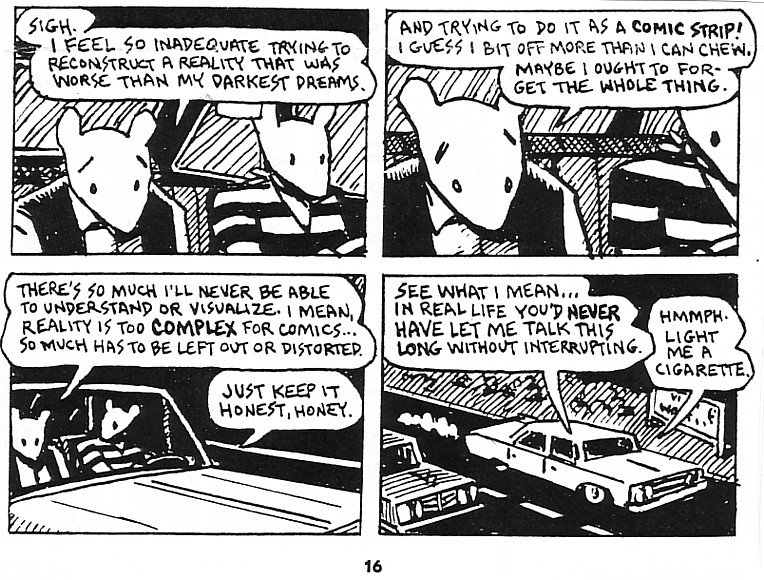
The story of Maus begins from around the 1930's and eventually leads up to 1944, and follows Vladek and his son, who interviews his father about his persecution by the Nazi's during World War II. The story sifts seamlessly between past and present as Art Spiegelman, the son, conducts his interview with his father over the years. At first Vladek's stubbornness and other touchy personality traits didn't really bother me, but as they became more obvious it started to bother me more how he had become like this when he had seemed to be such a different, happier person in the past. This story isn't like any normal historical literature. I think it's a really interesting take on history to put it into comic-book form like this - it's from a secondary source, but since it's illustrated and following a character who was fleshed out in the beginning, it makes history seem so much more real. As the reader you felt more connected because of this, so the tragedy feels even more dramatic and heartfelt. The reader can understand and even relate to Vladek's persecution since we are connected with him from the beginning (a good decision on his son's part to not just put in the history like any old history textbook. The bitterness Art's father exuded really did bother me after awhile though, in part because I remember when this wonderful lady named Patricia who had survived the Holocaust came to my school in 8th grade to give our class a talk about it and her experience, and she was one of the most lively and happiest people - she hadn't let this experience shape her whole life and bring her down, she had moved on and only told her story as a means to share information to a new generation. I feel like Vladek could've learned from another Holocaust survivor like this, one who put her horrible experiences behind her and knew the rest of her life she was would from then on could only be so much better.
Wednesday, October 5, 2011
Blankets - Craig Thompson
Blankets is the autobiographical tale of Craig Thompson's life - though he was only 27 when he wrote it - chronicling his life through boyhood and his teenage years, as well as early adulthood. The story begins with him as a young kid in middle school, supposedly somewhere around twelve or thirteen years old. The style is simplified, yet still holds relatively realistic proportions, and overall isn't too exaggerated. But in panels trying to capture his emotions or a conflict, the characters tend to become much more exaggerated in their expressions and movements to the degree of abstraction in some areas in order to better exemplify how he felt about them in the moment. He sets up the basic plot and themes for the rest of the story by explaining in his own words, how he had to sleep in the same bed with his younger brother in the exposed attic space. Though the words are narrating from a first-person view, they are in past tense, giving the sense that he is looking back on this portion of his life and the audience is peering into his memories and thoughts as he re-lives it. It begins in the winter-time, so the brothers playfully fight over the sheets like rambunctious little boys would, calling each other names and showing their playful relationship. Everything is fun until Craig is pushed from the bed from his little brother, and he falls to the floor loudly - his dad immediately stomps up the stairs from the clamorous thump, shouting at them to be quiet - this is the first display of how strict and short-tempered his parents are. The father's face throughout the scene is construed as over-exaggeratedly heartless and monstrous, the features blackened out in angry scribbles. The obedient fear towards his father made him feel helpless as his father takes his younger brother and shoves him in the spidery secret compartment and locks him in as punishment, where he cries quietly throughout the night. This scenario haunts Craig for the rest of the comic, as it makes him feel like he's a terrible, inadequate big brother. The audience follows Craig through what is a "normal" day for him in middle school, which is a miserable day by any comparison - bullies attack him multiple times throughout the day, making him late to class, which in turn causes the teacher to mock him, and later announce that the poem he wrote got an F and is rubbish. Upon returning home after such a horrible day however, when his mom asks how his day was, he replies that it was fine, showing that his days are probably normally pretty crappy, or else he would've complained to her. Boys his age (and throughout the teen years) tend to not consult with their mothers anyways, so his response also serves to illustrate both how normal and yet alienated he feels from people. Through scenes such as his fantasies in the nature around his house, the audience gets the idea that he is a loner and a day-dreamer. It's these thoughts that bring him to religion, which appeals to him as soon as he learns about heaven and how everyone is accepted there. He learns that it is a perfect place where everyone is happy, and immediately wants to go there to escape reality. His parents are Christian, as most families in the town appear to be, and force him to go to religious camp every year. Even there he feels like a loner among his peers, further depressing him and making him feel like a lonely loser - who isn't accepted at Christian camp? The comic sifts through his life timeline, jumping to his teen years as he goes through the motions and ends up at the camp every year. Though his childhood is revisited often in brief, random scenarios that further explain an aspect of his personality, the main time-line now follows him through his late teen years. At this point he has grown accustomed to going to camp every year and knows how to avoid the jocks and mean kids - he immediately looks for the "out-crowd," locating them on the fringes of the crowd of kids. Though he only gets along with the three guys in the group on a surface level, he immediately connects to the girl in the group, whom he quickly learns is named Raina. They separate from the group and quickly become best friends, doing everything together while escaping the guards that frequently try to force them into "required" activities such as church with the rest of the kids. Their relationship develops, and it isn't long before they both have feelings for each other and are obviously more than friends. The rest of the story continues to follow them and their relationship as it develops. Craig becomes extremely preoccupied with her, as he doesn't seem to have much else in his life besides his day-dreams and religion, which both keep him going along with spending time with her. They have many good times together, sharing special things with each other that they had never told or shown anyone else. They continue to grow closer before, later on in the story, Raina starts doing things Craig wouldn't expect of her, alienating him from her. He thought that they were both loners and both one in the same, but after she starts going to parties and participating in other social activities that he doesn't understand, their relationship falls apart. The story spirals, following his depressive emotions through his angsty thoughts. He says goodbye to her, moves out of his parent's house, and tries to move on, though the comic becomes mostly filled with his daydreams. In the end, they remain apart, but Craig finds a sort of equilibrium in his life and is able to move on.
Monday, September 19, 2011
Donald Duck and The Adventures of TinTin
We read some Donald Duck comics in class, and I was actually surprised that they weren't as lame as I thought they would be. Mickey/Donald Duck cartoons just never tickled me, so I assumed that the comics wouldn't be any funnier or more entertaining. Maybe it's the medium and the writer's well-placed beats that make it inherently funny, but I was pleasantly surprised. The comics I read were both Scrooge McDuck and Donald Duck comics though, and were both pretty much exactly the same, and I couldn't imagine how they could've had a whole series of comics surrounding those characters when they're so shallow and only really have one outstanding quality. Still, overall the comics were entertaining, though a little childish and drawn out.
TinTin is a comic originally made in Belgium (I actually thought it was England, but was corrected by a guy who overheard me talking about it and happened to really love the comics), but has spread around the entire world. It's pretty much popular everywhere except for in America for some reason, which makes me wonder why they're trying to make a movie here based on it. TinTin follows the fantastic adventures of a young boy, and is centralized around a few main, repeating characters with unique personality quirks. It's supposed to be a pretty humorous, adventurous comic, and is still running even though it was first published in the late twenties. The style is a mash-up of a simplistic and cartoony style for the characters, and detailed, realistic backgrounds. This makes the characters stand out and makes them more exaggerated and all-around more appealing to people, while still basing them in the real world and making them feel like they exist here. The colors are bright and vintagey, and the panels are pretty plain and evenly-spaced.
Wednesday, September 7, 2011
Little Nemo, Krazy Kat, Calvin and Hobbes, and Peanuts
McCay's Little Nemo is an older comic about a little boy's dreams. Each comic is only one page, but follows Nemo through a different dream each time, through fantastic worlds and terrifying events. Every page ends with Nemo waking up in bed (or on the floor, tangled in sheets), and either being yelled at by his parents or being consoled. Often-times his dream begins with him in bed before something crazy happens. King Morpheus is a re-occurring character in his dreams as well. Despite being a peek into a child's dreams, the dreams sometimes become dark and end with him about to die before he wakes up. The palette is colorful but soft, the lines fairly clean for being hand-inked. The story-lines of each comic strip are pretty random and nonsensical events stringed together with little (or very little) reason behind the events. The way it captures dreams so fluently is interesting, and even though each comic is so nonsensical, it's still really amusing to read and try to decipher.
In Krazy Kat by Herriman, the reader follows Krazy Kat, which is either a male or female cat (no one seems to know, and it changes). Events are hard to follow, as it seems in most of the comics there is a point where a character's motives change or the story just takes a totally different direction. There seems to always be a group after Kat trying to hurt him/her, even when he/she hasn't done anything. The bull-dog police officer often comes in to enforce the law and stop the others from hurting Kat.
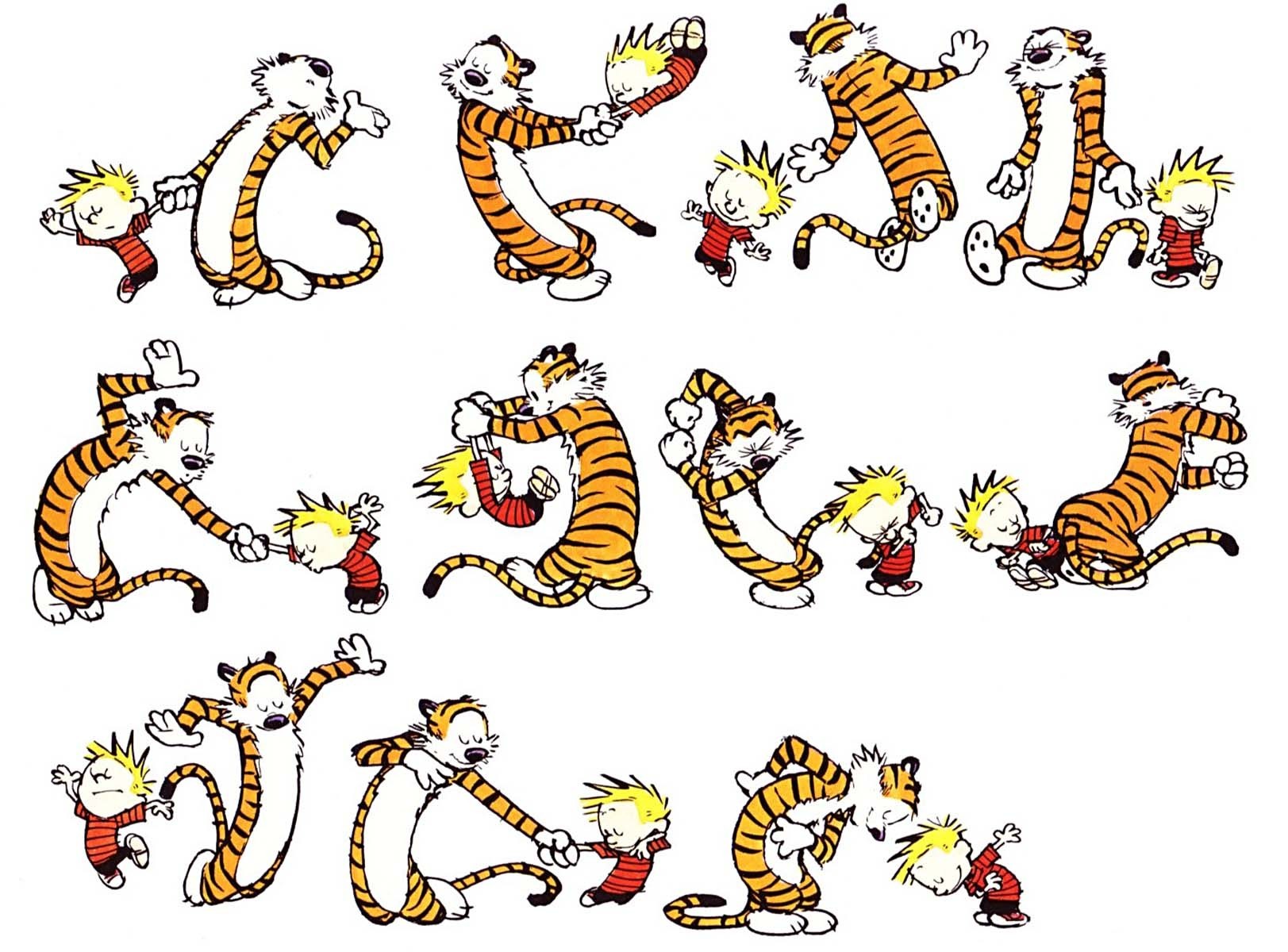
Calvin and Hobbes by Bill Watterson is a light-hearted, humorous black-and-white comic with an audience of all ages. The style is very cartoony, simplified, and fun. Each strip appears to only be 4 to 8 panels lined up side-by-side horizontally, but somehow manages to pack a punch. The story follows a little boy, Calvin, and his stuffed animal tiger, Hobbes, who everyone else sees as a stuffed animal, but whom Calvin sees as a real (friendly) tiger. Calvin and Hobbes are good friends and talk to each other, Hobbes often giving Calvin feedback as well as answering his questions. Every once in awhile Calvin asks Hobbes an existential question, to which Hobbes will give his own silly or clever answer. His parents and other adults don't comment on Calvin's talk to his tiger; they just seem to overlook it since he's a kid, though they know he shares a deep attachment to it. Calvin is shown to have a great imagination, and his attention-span has been called into question by adults. Hobbes is not always in every comic - sometimes the strip just focuses on Calvin as he does normal little kids, like playing in the sand-box, playing games, or eating dinner with his family. There are no backgrounds, or only very simple backgrounds; behind the characters is normally just white - besides that, there's only the characters and what they're interacting with. Later on, some of the comics are colored, but with minimal bright colors.
The Peanuts by Charles Shultz is another humorous comic with its own simplistic style similar to Calvin and Hobbes, focusing on a big group of kids in the same class, some friends and some not. The strip is normally a short 4-panel with evenly-spaced squares, and will revolve around the dialogue between two or more of the kids in their everyday lives. The kid's parents are never seen and rarely brought up. The humor is normally commentary on their lives or observations of the world. Backgrounds are minimal, if any, though there are some re-occurring locations such as a field, a brick wall, and doorsteps. The main characters are Charlie Brown, his Beagle Snoopy (who is confident, imaginative, and energetic, unlike Charlie Brown), Lucy (Charlie Brown's assertive, big-mouthed bully), Linus (Lucy's brother), Woodstock (Snoopy's little yellow bird-friend), Peppermint Patty (a tom-boy who has a crush on 'Charles'), Marcy (Peppermint Patty's best friend), and Sally (Charlie Brown's little sister). Many other characters from their class appear, though they are rarely focused on. Despite the comic running for so long, the kids don't seem to have aged at all. The comic takes place in their home-town, following them around the streets, school, and their homes. The humor is normally dry and linear, though every once in awhile an entire strip is wordless.
Wednesday, August 31, 2011
Understanding Comics - Scott McCloud
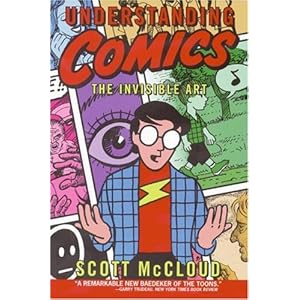
Scott McCloud begins by defining what a comic is, and the reader discovers it is much more complicated than it seems. He explains the similarity between movies and comics, the major difference being that space does for comics what time does for film, as film is shot all on one space while comic images are juxtaposed. After this he settles on a definition for comics: "Juxtaposed pictorial and other images in deliberate sequence." The icon, any image used to represent a person, place, thing, or idea, is brought up next, which leads into cartoons and simplification - why are we so drawn to cartoons as kids? McCloud says this stems from the simplicity of cartoons - when something is realistic, it is more substantial and defined less by us, but when something is cartoony and still a concept we can relate it to ourselves. He touches on how our identities are linked with many inanimate objects, such as clothes, our vehicle, and et cetera. Cartoons are concepts, and therefore, we bring our own life to them when we see them and relate to them. Nearly all comics employ a measure of cartooning. Since humans do not often identify with backgrounds, they tend to be more realistic. McCloud mentions that Japanese comics have evolved very differently than Western comics in many ways.
Words are the ultimate abstraction. Writing is perceived information that we have to decode from the symbols of the words, while pictures are instantaneously received information. The concept of closure is noted as a means to describe images. We then move on to define more comic terms such the gutter, the space between panels. Between these spaces we construct a continuous reality. There are different kind of panel-to-panel transitions to comics; Moment-to-Moment, which are short snaps of images close to each other, Action-to-Action, which are distinct progressions, Subject-to-Subject, which uses meaningful transitions and scene-to-scene takes place over great distances of time and/or space, Aspect-to-Aspect, which shows aspects of a place, idea, or mood, and lastly, Non-sequitur, which has no relationship between panels whatsoever. McCloud suggests that since we view comics as a sequential whole, panels are given meaning and therefore cannot be completely unrelated to each other. He discusses the use of these panel styles and their popularity by ratio in comics, and discovers the same formula for panel types is used fairly consistently. He returns to Japanese comic-making techniques and notes how they use Aspect-to-Aspect far more than any comics seen in the West, capturing a single moment within a scene through different panels. Through speculation we find that this may be because Western culture is so goal-oriented that we care more about what is happening and where we're going, while Japanese culture is known for having a focus on the moment.
Both panels and words work to create the illusion of time through their presentation. Each image is perceived as a moment, but when sound is introduced, we know more is going on in that single moment, and that more time must be passing than just a moment in order for the words to be said. When the words captioned though, a moment in time is held. Frames have no fixed or absolute meaning, but are the single most important element to comics. They act as a general indicator that time or space is being divided. The content of panels is what gives them meaning, but different panel shapes can affect reading experience.
When making comics McCloud gives six steps. One - Idea/Purpose, two - Form, three - Idiom, four - Structure, five - Craft, and six - Surface. Many amateurs who want to make comics may have the skill in draftsmanship, but lack the idea and purpose, making their work hollow. Pacing, composition, thematic development, and genres all play a part in understanding the forms and ideas of comics. Even those who have reached the pinnacle of success in comics, having created their own idioms and garnered high acclaim for their works, may feel like there should be more to what they do. To this, McCloud says that he thinks we all have something to say, but the question is whether others want to listen. Those at this stage can revolutionize their art by questioning the medium itself and advancing it through form, or use it as a tool to tell stories as effectively as possible. Any artist creating any work in any medium follows these six steps, but the more a creator learns to control every aspect and their relationships to them, the more likely they are to succeed. Once artists find the core of art, the most important question is asked: Why am I doing this?
Words are the ultimate abstraction. Writing is perceived information that we have to decode from the symbols of the words, while pictures are instantaneously received information. The concept of closure is noted as a means to describe images. We then move on to define more comic terms such the gutter, the space between panels. Between these spaces we construct a continuous reality. There are different kind of panel-to-panel transitions to comics; Moment-to-Moment, which are short snaps of images close to each other, Action-to-Action, which are distinct progressions, Subject-to-Subject, which uses meaningful transitions and scene-to-scene takes place over great distances of time and/or space, Aspect-to-Aspect, which shows aspects of a place, idea, or mood, and lastly, Non-sequitur, which has no relationship between panels whatsoever. McCloud suggests that since we view comics as a sequential whole, panels are given meaning and therefore cannot be completely unrelated to each other. He discusses the use of these panel styles and their popularity by ratio in comics, and discovers the same formula for panel types is used fairly consistently. He returns to Japanese comic-making techniques and notes how they use Aspect-to-Aspect far more than any comics seen in the West, capturing a single moment within a scene through different panels. Through speculation we find that this may be because Western culture is so goal-oriented that we care more about what is happening and where we're going, while Japanese culture is known for having a focus on the moment.
Both panels and words work to create the illusion of time through their presentation. Each image is perceived as a moment, but when sound is introduced, we know more is going on in that single moment, and that more time must be passing than just a moment in order for the words to be said. When the words captioned though, a moment in time is held. Frames have no fixed or absolute meaning, but are the single most important element to comics. They act as a general indicator that time or space is being divided. The content of panels is what gives them meaning, but different panel shapes can affect reading experience.
When making comics McCloud gives six steps. One - Idea/Purpose, two - Form, three - Idiom, four - Structure, five - Craft, and six - Surface. Many amateurs who want to make comics may have the skill in draftsmanship, but lack the idea and purpose, making their work hollow. Pacing, composition, thematic development, and genres all play a part in understanding the forms and ideas of comics. Even those who have reached the pinnacle of success in comics, having created their own idioms and garnered high acclaim for their works, may feel like there should be more to what they do. To this, McCloud says that he thinks we all have something to say, but the question is whether others want to listen. Those at this stage can revolutionize their art by questioning the medium itself and advancing it through form, or use it as a tool to tell stories as effectively as possible. Any artist creating any work in any medium follows these six steps, but the more a creator learns to control every aspect and their relationships to them, the more likely they are to succeed. Once artists find the core of art, the most important question is asked: Why am I doing this?
Thursday, August 25, 2011
Mark Ernst - A Week of Kindness
Analysis of A Week of Kindness
First panel - A gypsy woman is dancing on the street with a chicken standing one-legged on a ball with a nebulous-looking form above its head. A circular tray of what looks like about thirty eggs lay on the cobble-stone street, the background inhabited by a building wall and part of a stairway. The chicken could be transforming, but there is something about this moment that is eerie and special.
Second panel - A giant hybrid bird-like man stands over an unconscious woman laying on a table in a room (possibly the same gypsy?), his head of a chicken, but his legs a man's, with giant bird wings hanging. A chicken stands beside him on the ground. The room appears to be a kitchen or dining room of some sort, with a fancy bookcase and two hanging candle-lit chandeliers in the background. From the first panel on, roosters are in each panel in some way.
Third panel - The same chicken-man hybrid, but now with more metallic-looking wings, stands off with a rooster-hybrid man of the same sort, and now we see that the upper body is that of the animal and the lower body fades into human, beginning with a man's vest partly down the chest. This darker rooster is carrying what looks like a gas lamp. They are on opposite sides of a pit with a woman laying in it, seemingly dead, but peaceful, a nude angel carrying flurrying cloth behind the pit she lays in with a stone alter and candles lit on it, implying the inside of a church.
Fourth panel - The two hybrid animal-men seem to be mourning over the pit, crouched down at the foot together, the nude figure laying on the stone tablet cover of the tomb. The background is evidently a church, as seen by the enormous stone archways, roman pillars with nude religious-looking figures, and saints engraved in stone on above-ground stone tombs behind them. A top-hat lays on the ground behind the white rooster-hybrid, and a small, simplistic-looking tree appears to be sprouting from the pit's grave, though from the angle, the reader cannot see the woman in the pit anymore. The dark rooster-man is holding a cloth, possibly the cloth of the angel (that is the nude woman laying on the stone tablet) that was unraveled. Both rooster-men have folded their wings in, or in the white rooster's case, appear to be doing so in the panel, and are in their suits again.
Fifth panel - A woman who appears to be in her night-gown is laying face-down in her own pool of blood, her bed-sheets still tangled around her. The bed to the left is lumpy and disturbed, a rooster standing on top of the covers. Another rooster stands up front of the panel, partly in front of the injured woman, and a hybrid chicken-man, now in a suit and without his wings, stands in the open doorway. Curtains drape from the large bed and over an inlet room in the background with a water pot sitting on a table before an oval mirror on the wall. The room seems decadent, the rooster raising his arms and tilting his head back, his beak open to the sky as if in either jubilance or horror.
Sixth panel - A woman in a nice 18th-century dress appears entranced by a man in a suit as he dances before her in a living room, a large fire-place in the background, and a stone decorated wall-column behind him. The rooster-man hybrid peeks from behind the stone column, seemingly coming out of the wall to spy on or watch the man.
Overall, the story has repeating elements such as the woman, a man in a suit, the roosters, and the hybrid rooster-men, but the story is ambiguous and hard to follow. The reader tries to connect the panels and make sense of them. The sequence and ordering of this sequence of panels leaves a lot open.
These panels were compiled through collage, then photographed to flatten the collage elements. Mark Ernst was the first to use collage.
First panel - A gypsy woman is dancing on the street with a chicken standing one-legged on a ball with a nebulous-looking form above its head. A circular tray of what looks like about thirty eggs lay on the cobble-stone street, the background inhabited by a building wall and part of a stairway. The chicken could be transforming, but there is something about this moment that is eerie and special.
Second panel - A giant hybrid bird-like man stands over an unconscious woman laying on a table in a room (possibly the same gypsy?), his head of a chicken, but his legs a man's, with giant bird wings hanging. A chicken stands beside him on the ground. The room appears to be a kitchen or dining room of some sort, with a fancy bookcase and two hanging candle-lit chandeliers in the background. From the first panel on, roosters are in each panel in some way.
Third panel - The same chicken-man hybrid, but now with more metallic-looking wings, stands off with a rooster-hybrid man of the same sort, and now we see that the upper body is that of the animal and the lower body fades into human, beginning with a man's vest partly down the chest. This darker rooster is carrying what looks like a gas lamp. They are on opposite sides of a pit with a woman laying in it, seemingly dead, but peaceful, a nude angel carrying flurrying cloth behind the pit she lays in with a stone alter and candles lit on it, implying the inside of a church.
Fourth panel - The two hybrid animal-men seem to be mourning over the pit, crouched down at the foot together, the nude figure laying on the stone tablet cover of the tomb. The background is evidently a church, as seen by the enormous stone archways, roman pillars with nude religious-looking figures, and saints engraved in stone on above-ground stone tombs behind them. A top-hat lays on the ground behind the white rooster-hybrid, and a small, simplistic-looking tree appears to be sprouting from the pit's grave, though from the angle, the reader cannot see the woman in the pit anymore. The dark rooster-man is holding a cloth, possibly the cloth of the angel (that is the nude woman laying on the stone tablet) that was unraveled. Both rooster-men have folded their wings in, or in the white rooster's case, appear to be doing so in the panel, and are in their suits again.
Fifth panel - A woman who appears to be in her night-gown is laying face-down in her own pool of blood, her bed-sheets still tangled around her. The bed to the left is lumpy and disturbed, a rooster standing on top of the covers. Another rooster stands up front of the panel, partly in front of the injured woman, and a hybrid chicken-man, now in a suit and without his wings, stands in the open doorway. Curtains drape from the large bed and over an inlet room in the background with a water pot sitting on a table before an oval mirror on the wall. The room seems decadent, the rooster raising his arms and tilting his head back, his beak open to the sky as if in either jubilance or horror.
Sixth panel - A woman in a nice 18th-century dress appears entranced by a man in a suit as he dances before her in a living room, a large fire-place in the background, and a stone decorated wall-column behind him. The rooster-man hybrid peeks from behind the stone column, seemingly coming out of the wall to spy on or watch the man.
Overall, the story has repeating elements such as the woman, a man in a suit, the roosters, and the hybrid rooster-men, but the story is ambiguous and hard to follow. The reader tries to connect the panels and make sense of them. The sequence and ordering of this sequence of panels leaves a lot open.
These panels were compiled through collage, then photographed to flatten the collage elements. Mark Ernst was the first to use collage.
Wednesday, August 24, 2011
Shaun Tan - The Arrival

From observing small details in the beginning panels the reader can tell these are snapshots of a mid to lower-middle class home. The clothes on the coat rack are a man's hat and shirt, the cooking pots imply a woman, and the family is finally given away with the kid-drawing of the three of them together. More hints to their class are given by details such as the worn chips and cracks in their belongings, and a packed suitcase is shown, implying that one or more of them are leaving. From the first page alone, the reader has been given all the information they need to know what's happening, who is involved, and where the setting is. The panels are fairly simple, but extremely readable. Each one may only display an expression or an action in sequence, but the timing and flow of action never leaves the reader confused or left behind - Tan leads the reader through the pages at an easy, natural pace, almost like key-frames or a story-board would. Each new page seems to begin a new sequence or "scene," often beginning on one object before zooming out or moving around the scene to reveal more of the setting and what's taking place. The reader is given little "eye candy breaks" with full-page illustrations depicting the full scene before Tan returns to the next sequence of small panels. Textures and soft variances of color within the gray palette of the comic add a new setting element and visual interest, dropping the reader into a 19th-century time period through the comic's visual style alone. It is evident that each panel is treated with great care and detail. The space a panel is allotted on the page is also detrimental to timing and the importance of events in that panel, such as giving larger panels more visual impact. Panel sizes, along with the number of panels per page and the full-page "eye-candy" breaks are expertly varied. The reader continues to follow the family as they leave the house (avoiding the giant, ominous monster that is plaguing their city), say goodbye to the husband before he travels across the sea on a ship crowded with other people, and arrives in an alternate-world type New York. Despite the world being different, most evidently, by the fantastical creatures inhabiting it, Tan uses familiar symbols and places to keep the reader grounded. The immigrants arrive in what appears to be 1920's New York, the Statue of Liberty only replaced by two large statues exchanging gifts in peace, and the skyscrapers in the distance abuzz with hazy shapes of flying creatures. As was procedure on Ellis Island in the 1920's, the immigrants getting off the ship are checked over for health problems before being allowed to pass. Gestures and facial expressions on the characters are also integral to understanding their emotions and what's happening. The husband, now separated from his family, is given bad news in a page of "conversation" facial expressions, illustrating his fall from confusing, to arguing, to deep disappointment. From there he is sent out in a hot air balloon over the alien landscape, still rooted in our world by familiar transportation systems such as streets and recreational and architectural familiarities such as parks and New York-style buildings (only reiterated slightly). As the man looks around, we see what he sees, and are presented with snapshots of people in everyday life interacting with strange creatures. The reader connects with the man, having followed him all the way from home, and is now experiencing the same alienated feeling he encounters. The written language is different and even the time on the big street-corner seems unreadable. You are placed in the shoes of an immigrant in a new world. Lighting and composition not only create a mood, but also lead the reader's eye from panel to panel, showing them what's most important. More clues are given here and there that make the reader feel like the man is from a more realistic world closer to our own, such as when he pulls a lever connected to a faucet to get water, and is only sprayed by a pipe, or when he wants to hammer a nail into the wall to hang the picture of his family and uses the sole of his shoe. The narrative diverses when the man meets a woman who helps him find the flying vessel he wants to take, and as they sit together, she tells his story to him in a few brief pages of panels displaying key moments from her life. The story continues to follow the man, taking other short interludes into the stories of people he meets as he tries to find a job and learns the ways of this new world. The scenes, though ethereal, are depicted beautifully. Time is depicted passing through the sprout, growth, bloom, and death of a flower through seasons, all throughout two pages. The familiar building the man resides in, shown earlier, is now covered in snow. When the man receives a letter that his family is going to arrive, time speeds up between panels, more events happening between each one to make it appear that time is moving much quicker.
Overall the timing, placement of panels, choice of light, color, composition, and the use of space Tan decided to use created an easy to follow, riveting tale that drew the reader in with its natural rhythm. The story feels similar to reading a book, except our eyes were only carried through the expert use of visuals. Through the use of these elements and skill, Tan brought to life a complex story without the use of a single word.
Subscribe to:
Posts (Atom)