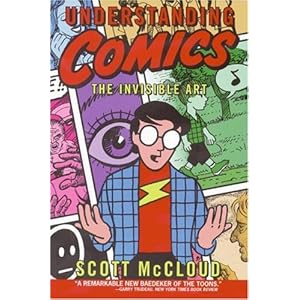
Words are the ultimate abstraction. Writing is perceived information that we have to decode from the symbols of the words, while pictures are instantaneously received information. The concept of closure is noted as a means to describe images. We then move on to define more comic terms such the gutter, the space between panels. Between these spaces we construct a continuous reality. There are different kind of panel-to-panel transitions to comics; Moment-to-Moment, which are short snaps of images close to each other, Action-to-Action, which are distinct progressions, Subject-to-Subject, which uses meaningful transitions and scene-to-scene takes place over great distances of time and/or space, Aspect-to-Aspect, which shows aspects of a place, idea, or mood, and lastly, Non-sequitur, which has no relationship between panels whatsoever. McCloud suggests that since we view comics as a sequential whole, panels are given meaning and therefore cannot be completely unrelated to each other. He discusses the use of these panel styles and their popularity by ratio in comics, and discovers the same formula for panel types is used fairly consistently. He returns to Japanese comic-making techniques and notes how they use Aspect-to-Aspect far more than any comics seen in the West, capturing a single moment within a scene through different panels. Through speculation we find that this may be because Western culture is so goal-oriented that we care more about what is happening and where we're going, while Japanese culture is known for having a focus on the moment.
Both panels and words work to create the illusion of time through their presentation. Each image is perceived as a moment, but when sound is introduced, we know more is going on in that single moment, and that more time must be passing than just a moment in order for the words to be said. When the words captioned though, a moment in time is held. Frames have no fixed or absolute meaning, but are the single most important element to comics. They act as a general indicator that time or space is being divided. The content of panels is what gives them meaning, but different panel shapes can affect reading experience.
When making comics McCloud gives six steps. One - Idea/Purpose, two - Form, three - Idiom, four - Structure, five - Craft, and six - Surface. Many amateurs who want to make comics may have the skill in draftsmanship, but lack the idea and purpose, making their work hollow. Pacing, composition, thematic development, and genres all play a part in understanding the forms and ideas of comics. Even those who have reached the pinnacle of success in comics, having created their own idioms and garnered high acclaim for their works, may feel like there should be more to what they do. To this, McCloud says that he thinks we all have something to say, but the question is whether others want to listen. Those at this stage can revolutionize their art by questioning the medium itself and advancing it through form, or use it as a tool to tell stories as effectively as possible. Any artist creating any work in any medium follows these six steps, but the more a creator learns to control every aspect and their relationships to them, the more likely they are to succeed. Once artists find the core of art, the most important question is asked: Why am I doing this?

No comments:
Post a Comment