
McCay's Little Nemo is an older comic about a little boy's dreams. Each comic is only one page, but follows Nemo through a different dream each time, through fantastic worlds and terrifying events. Every page ends with Nemo waking up in bed (or on the floor, tangled in sheets), and either being yelled at by his parents or being consoled. Often-times his dream begins with him in bed before something crazy happens. King Morpheus is a re-occurring character in his dreams as well. Despite being a peek into a child's dreams, the dreams sometimes become dark and end with him about to die before he wakes up. The palette is colorful but soft, the lines fairly clean for being hand-inked. The story-lines of each comic strip are pretty random and nonsensical events stringed together with little (or very little) reason behind the events. The way it captures dreams so fluently is interesting, and even though each comic is so nonsensical, it's still really amusing to read and try to decipher.
In Krazy Kat by Herriman, the reader follows Krazy Kat, which is either a male or female cat (no one seems to know, and it changes). Events are hard to follow, as it seems in most of the comics there is a point where a character's motives change or the story just takes a totally different direction. There seems to always be a group after Kat trying to hurt him/her, even when he/she hasn't done anything. The bull-dog police officer often comes in to enforce the law and stop the others from hurting Kat.
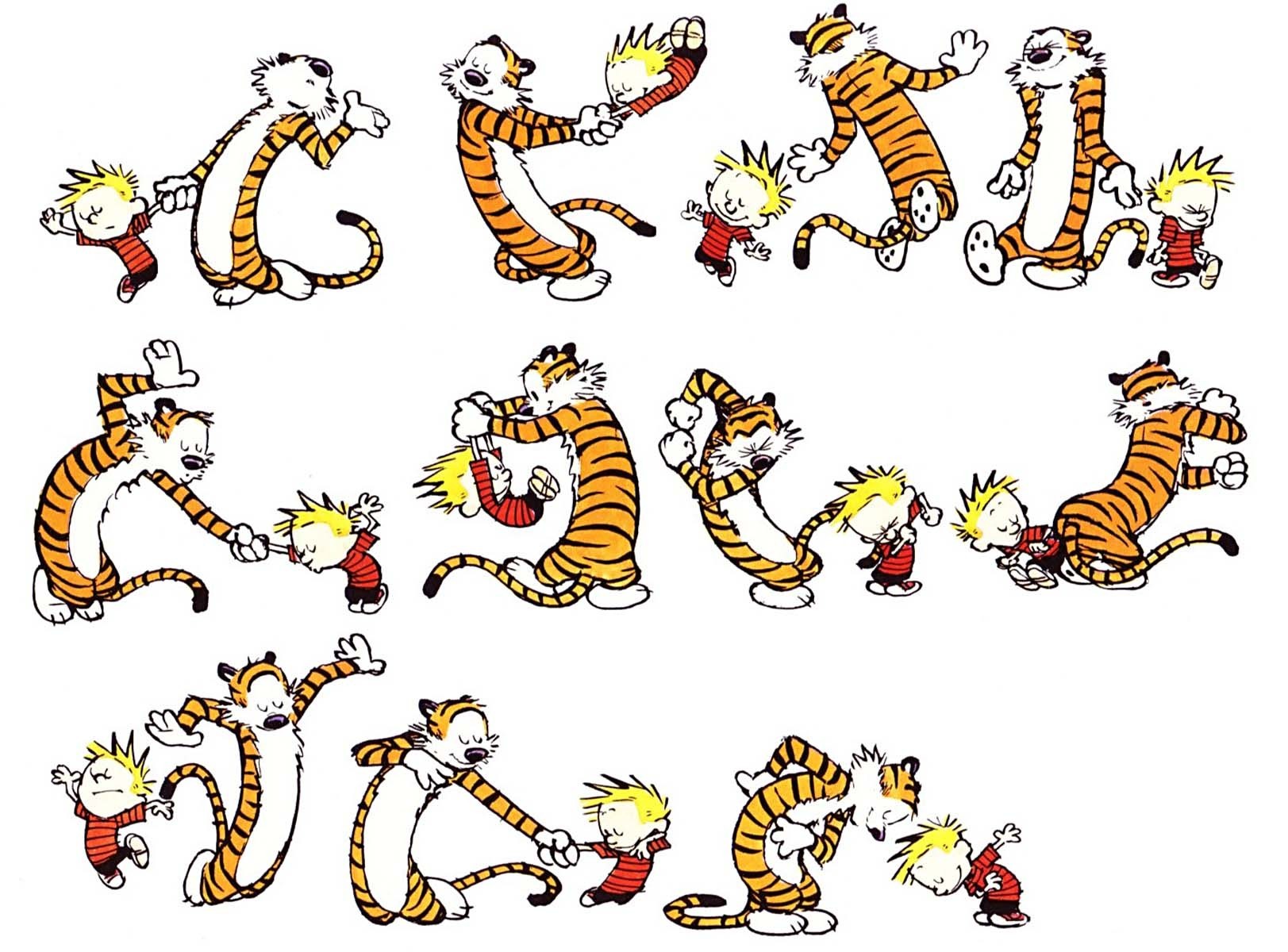
Calvin and Hobbes by Bill Watterson is a light-hearted, humorous black-and-white comic with an audience of all ages. The style is very cartoony, simplified, and fun. Each strip appears to only be 4 to 8 panels lined up side-by-side horizontally, but somehow manages to pack a punch. The story follows a little boy, Calvin, and his stuffed animal tiger, Hobbes, who everyone else sees as a stuffed animal, but whom Calvin sees as a real (friendly) tiger. Calvin and Hobbes are good friends and talk to each other, Hobbes often giving Calvin feedback as well as answering his questions. Every once in awhile Calvin asks Hobbes an existential question, to which Hobbes will give his own silly or clever answer. His parents and other adults don't comment on Calvin's talk to his tiger; they just seem to overlook it since he's a kid, though they know he shares a deep attachment to it. Calvin is shown to have a great imagination, and his attention-span has been called into question by adults. Hobbes is not always in every comic - sometimes the strip just focuses on Calvin as he does normal little kids, like playing in the sand-box, playing games, or eating dinner with his family. There are no backgrounds, or only very simple backgrounds; behind the characters is normally just white - besides that, there's only the characters and what they're interacting with. Later on, some of the comics are colored, but with minimal bright colors.
The Peanuts by Charles Shultz is another humorous comic with its own simplistic style similar to Calvin and Hobbes, focusing on a big group of kids in the same class, some friends and some not. The strip is normally a short 4-panel with evenly-spaced squares, and will revolve around the dialogue between two or more of the kids in their everyday lives. The kid's parents are never seen and rarely brought up. The humor is normally commentary on their lives or observations of the world. Backgrounds are minimal, if any, though there are some re-occurring locations such as a field, a brick wall, and doorsteps. The main characters are Charlie Brown, his Beagle Snoopy (who is confident, imaginative, and energetic, unlike Charlie Brown), Lucy (Charlie Brown's assertive, big-mouthed bully), Linus (Lucy's brother), Woodstock (Snoopy's little yellow bird-friend), Peppermint Patty (a tom-boy who has a crush on 'Charles'), Marcy (Peppermint Patty's best friend), and Sally (Charlie Brown's little sister). Many other characters from their class appear, though they are rarely focused on. Despite the comic running for so long, the kids don't seem to have aged at all. The comic takes place in their home-town, following them around the streets, school, and their homes. The humor is normally dry and linear, though every once in awhile an entire strip is wordless.

No comments:
Post a Comment